

We Remember the Teacher. But Did We Learn His Lesson?
Published on: Sat Sep 5, 2026 3:16PM
If Radhakrishnan Were Our Teacher Today..
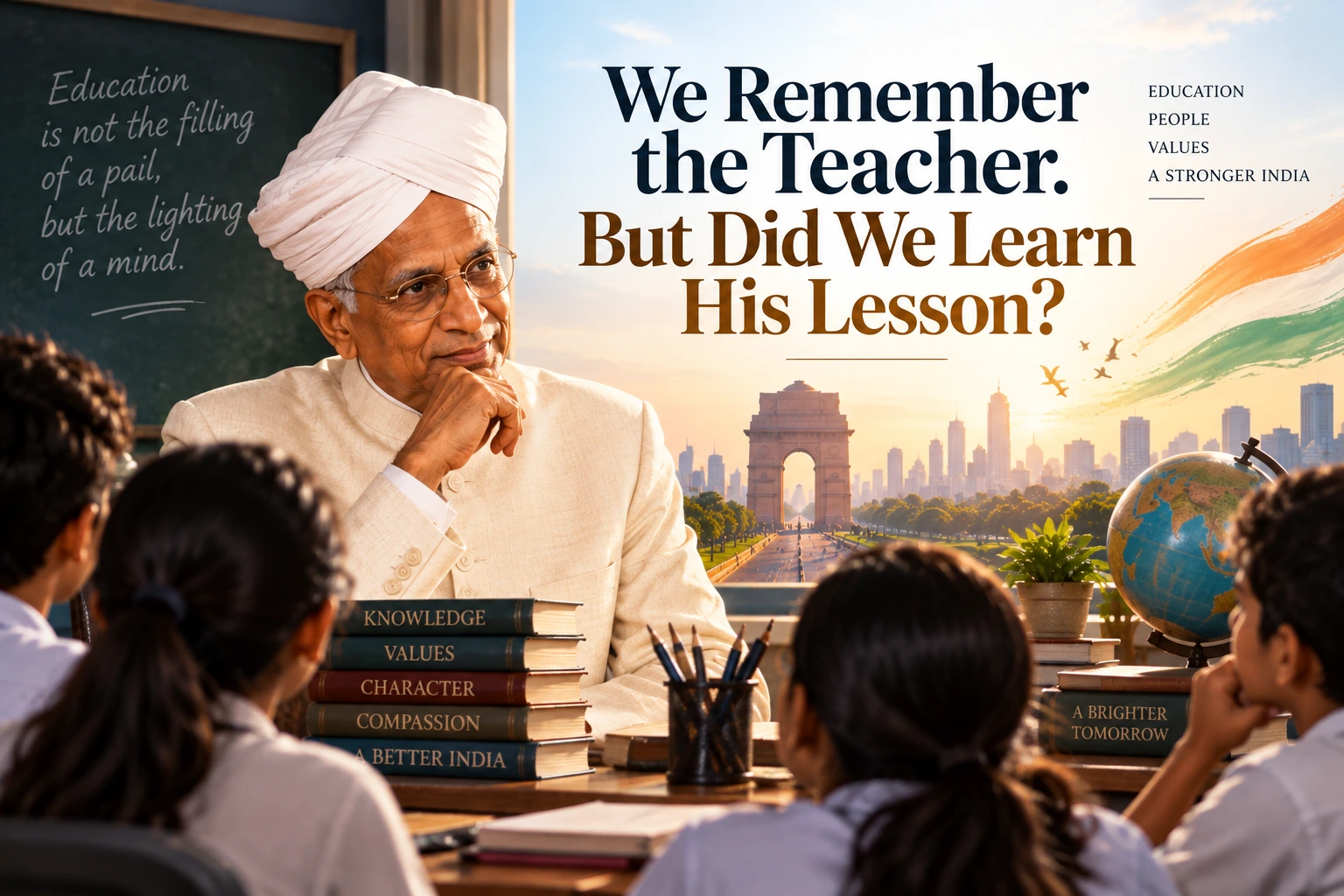
Every year on September 5, India celebrates Teachers' Day in memory of Dr. Sarvepalli Radhakrishnan.
We remember his photographs.
We remember his achievements.
We send wishes to our teachers.
But this year, I want to look at him differently.
Instead of asking who Dr. Radhakrishnan was, I want to ask what he would teach us if he were our teacher today.
Because the world he lived in and the world we live in are very different.
But one question remains the same:
What is the real purpose of education?
We have educated people. But are we creating an educated society?
Today, knowledge is everywhere.
A student can access the world's greatest books, universities, lectures and information through a mobile phone.
Artificial intelligence can answer questions in seconds.
Technology can teach us almost anything.
But having information is not the same as having wisdom.
We may know how to use technology, but do we know how to use it responsibly?
We may have excellent qualifications, but do we have character?
We may know how to build successful careers, but do we know how to build a better society?
Perhaps Radhakrishnan would remind us that education should not only change our income. It should change our thinking.
If he walked into today's classroom..
.webp)
Perhaps he wouldn't begin by asking students how many marks they scored.
He might ask:
“What have you learned that has made you a better human being?”
Because marks can measure performance.
Degrees can prove qualification.
But neither automatically measures wisdom, empathy, courage or responsibility.
A truly educated person should be able to think independently, question intelligently and respect another person's point of view.
If he saw our relationship with technology..
.webp)
I don't think he would tell us to reject technology.
He would probably tell us to master it.
Use the internet.
Use artificial intelligence.
Use every tool that can expand human potential.
But never surrender your ability to think.
Because a machine can give us an answer.
Human beings still have to decide what is right.
That distinction will become even more important as AI becomes a larger part of our lives.
If he saw today's parents..
.webp)
Perhaps he would ask us to redefine what we mean by success.
We want our children to become doctors, engineers, entrepreneurs, scientists, administrators and leaders.
Nothing wrong with that.
But are we equally concerned about the kind of human beings they become?
A child can achieve everything society considers successful - and still lack compassion.
A child can win every competition - and still be unable to accept failure.
A child can earn millions - and still not know how to contribute meaningfully to society.
Education must prepare a child not only to earn a living, but to live responsibly.
If he saw today's teachers..
.webp)
Perhaps he would remind us that a teacher's influence goes far beyond the classroom.
A teacher can create confidence in a child who has none.
A teacher can discover talent that nobody else noticed.
A teacher can change the direction of an entire life.
That is why teaching is not simply a profession.
It is nation-building at its earliest stage.
The classroom of today can become the society of tomorrow.
If he looked at India..
.webp)
This is where his message becomes even more important.
We often talk about building a developed India.
We talk about world-class infrastructure.
Modern cities.
Advanced technology.
Economic growth.
Global leadership.
All of these matter.
But a truly developed nation cannot be created only with buildings, roads, technology and money.
It needs developed citizens.
Citizens who follow rules even when nobody is watching.
Citizens who keep their surroundings clean.
Citizens who respect women, workers and fellow citizens.
Citizens who can disagree without hatred.
Citizens who question leaders without destroying institutions.
Citizens who understand that freedom also comes with responsibility.
Perhaps this is where education has its greatest role.
The India we build begins with the person we educate
We often ask:
“What kind of India do we want?”
Perhaps we should first ask:
“What kind of Indian are we creating?”
Because a nation is ultimately a reflection of its people.
If we want cleaner cities, we need responsible citizens.
If we want honest institutions, we need people who value integrity.
If we want innovative India, we need curious minds.
If we want compassionate India, we need empathetic people.
If we want strong leadership, we need educated citizens capable of thinking beyond themselves.
And that transformation begins long before someone enters Parliament, a government office, a company or a laboratory.
It begins in the classroom.
Perhaps that is the real meaning of Teachers' Day
Maybe Teachers' Day should not be only about remembering our teachers.
It should also be about remembering what education is supposed to accomplish.
Radhakrishnan rose from a teacher and philosopher to become one of the highest constitutional authorities in India.
Yet his identity as a teacher remained central to his legacy.
There is something profound in that.
He reached the highest office.
But he did not make power the centre of his identity.
Knowledge was. Education was. Learning was.
That is a lesson worth remembering.
So today, instead of simply saying:
“Happy Teachers' Day,”
perhaps we should ask ourselves a more difficult question:
Are we actually becoming the people our teachers wanted us to become?
Are we thinking more deeply?
Are we becoming more responsible?
Are we using knowledge to help others?
Are we raising children who will build a better India?
Are we creating an education system that produces not just successful professionals, but responsible citizens?
Because the real tribute to Dr. Sarvepalli Radhakrishnan is not remembering his birthday once a year.
It is creating the kind of educated, thoughtful and responsible India that education was meant to build.
And perhaps that is the question we should carry beyond September 5:
If education is the foundation of a nation, then what kind of nation are we building through the education we give our children today?
The future of India may not be decided only by what we teach our children.
It will be decided by what our children become because of what we taught them.
Written by Sreekanth Damacharla Ideas for a Better India