


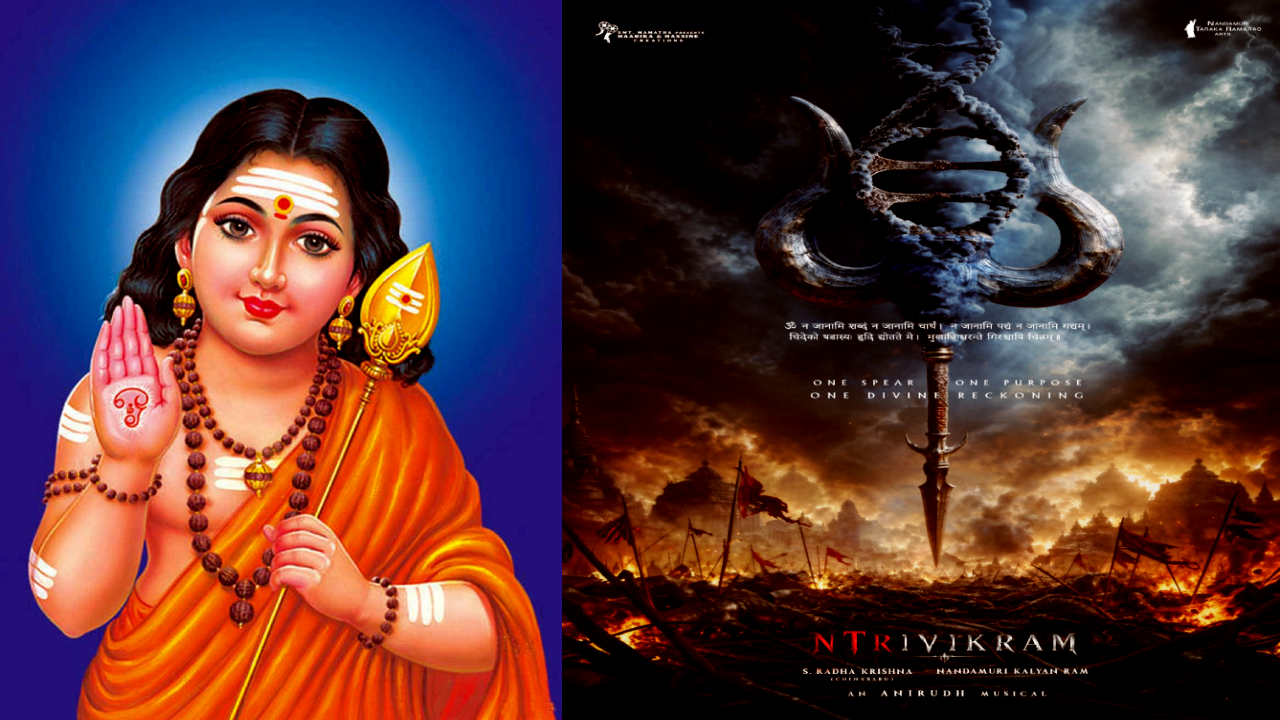
A recent controversy surrounding NTR and Trivikram Srinivas' upcoming mythological adaptation has once again sparked a debate on the identity of Lord Murugan. While some social media users have claimed that Murugan is exclusively a Tamil deity and objected to his portrayal in a pan-Indian context, the descriptions found in Hindu scriptures present a much broader picture.
The controversy arose because makers of the film used Adi Shankaracharya Hymm and then described, "Born in the North. Forged in the Heartland. Worshipped in the South. Now... A tale destined to belong to the universe." Born in the North became objectionable claiming that Murugan is Adi Tamilian and only Tamil deity. Let's look into the origin story of Lord Shiva's son and then come to a conclusion about the same.
Across Hindu tradition, Lord Shiva's son is worshipped under many names—Skanda, Karthikeya, Kumara, Subrahmanya, Saravanabhava, Shanmukha and Murugan. These are not different gods but different names and forms of the same deity. The variations largely reflect language, regional traditions and specific aspects of his divine personality rather than separate identities.
According to the Skanda Purana, the largest of the Mahapuranas and one named after the deity himself, Skanda is born to destroy the demon Tarakasura, whose boon made him invincible except to a son of Shiva. Since Shiva was immersed in deep penance after the death of Sati, the gods sought the union of Shiva and Parvati, leading to the birth of Skanda, the commander of the celestial army.
The story is also narrated in the Shiva Purana, where Shiva's divine energy manifests as six sparks. These sparks are carried to the sacred reeds of Saravana, where six infants are nurtured by the Krittika maidens. Goddess Parvati later embraces the six children into one, giving rise to the six-faced deity known as Shanmukha. Because he was born in Saravana, he is called Saravanabhava. Since he was raised by the Krittikas, he is known as Karthikeya. As the son who embodies supreme spiritual knowledge, he is revered as Subrahmanya.
Tamil literature gives Murugan an especially cherished place. Ancient Sangam works such as the Tirumurukarruppatai celebrate him as the guardian of the Tamil landscape, while later devotional classics like the Kanda Puranam and the hymns of Arunagirinathar deepened Murugan worship across Tamil Nadu. For millions of devotees, Murugan is deeply intertwined with Tamil culture, language and identity.
At the same time, his worship has never been confined to one region. As Subrahmanya, he is revered in Andhra Pradesh, Karnataka and Kerala. As Kartikeya, he is worshipped in North and Eastern India. Major temples dedicated to him exist across the country, and his legends are found in Sanskrit Puranas that predate many regional retellings. His festivals, including Skanda Sashti and Thaipusam, are celebrated by devotees in India and across the world.
Indian mythology has always evolved through regional storytelling. The same deity often carries different names, iconography and local traditions while remaining fundamentally the same divine figure. Krishna is celebrated differently in Mathura, Udupi and Manipur; Shiva is worshipped in countless forms across the country; similarly, Murugan, Skanda and Karthikeya represent different cultural expressions of one deity.
As debates unfold around cinematic interpretations, the scriptural record makes one point clear: Murugan, Skanda, Karthikeya, Subrahmanya and Saravanabhava are names of the same son of Shiva, born to defeat Tarakasura. Regional devotion has enriched his legacy, but the Puranas describe him as a deity whose significance extends across the Hindu tradition rather than belonging exclusively to any one linguistic or geographic community.
Disclaimer: This article is based on discussions and information shared across publicly available sources and social media. Interpretations remain those of the users involved. Readers are encouraged to exercise discretion before drawing conclusions.