|  We
all know the coming New Year is the beginning of a new year for
all the people all over the world. But according to the Hindu calendar,
every caste has its own celebration of their New Year. For us in
Hyderabad Pongal is the New Year. We
all know the coming New Year is the beginning of a new year for
all the people all over the world. But according to the Hindu calendar,
every caste has its own celebration of their New Year. For us in
Hyderabad Pongal is the New Year.
Moving towards North, the state of
jovial and fun-loving people – Punjab, celebrates its New
Year in April. Baisakhi is the name given to their New Year. Baisakhi
is celebrated at the end of months of hard labour that have gone
into the production of the Rabi crop, the first harvest of the year.
The festival comes as a welcome relief to farmers after their crops
have been sold off in the markets, leaving them free to join in
the revelries.
According to the solar calendar, 14th
April is celebrated as Baisakhi every year. By this festival, farmers
thank the god for his blessings in the form of good harvest.
The day of the festival usually starts
with people taking bath in the rivers and huge water tanks. However,
this is not possible in the cities. The idea of having bath in the
rivers is absolutely refreshing. After the bath, men and women dress
traditionally and visit the Guruduwara, a place of worship of Sikhs,
with sweets and one-tenth of their earnings served to the Lord.
After taking the Prasad, Langar – community lunch is organized
at the Guruduwara.
As a festival, Baisakhi is of great
religious significance for the Sikhs. The panch piyara (the five
loved ones) of the Sikh religion was initiated by Guru Gobind Singh
(the tenth and last Sikh guru) on Baisakhi. The holy book of the
Sikhs – Khalsa was established on this very day and from then
it is decorated on every Baisakhi. As in Hindus, a bath in the river
Ganga washes away all the sins of a person; similarly Sikhs take
ritual bath in the Sarovar Lake in Amritsar to purify the body and
soul on the day of Baisakhi.
 A
number of fairs are organized at this time of the year. Cattle fairs
are held all over the place. Mouth-watering delicacies like ice
cream, flossy sugar lollipops and chaat are consumed in large quantities
by the young and old alike with great relish. Quaint wooden and
clay toys vie with exquisite handicrafts and mundane household goods
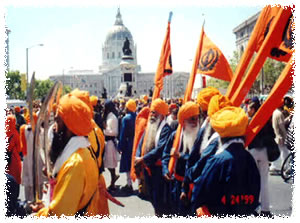
for shelf space are put up in the fairs. Processions are taken out,
at the head of which are the panch piyara. Mock duels and bands
playing religious tunes are part of the processions. Children also
enthusiastically take part in them. People come from far and wide
to attend these annual fairs and join in the general hustle and
bustle of the day. A
number of fairs are organized at this time of the year. Cattle fairs
are held all over the place. Mouth-watering delicacies like ice
cream, flossy sugar lollipops and chaat are consumed in large quantities
by the young and old alike with great relish. Quaint wooden and
clay toys vie with exquisite handicrafts and mundane household goods
for shelf space are put up in the fairs. Processions are taken out,
at the head of which are the panch piyara. Mock duels and bands
playing religious tunes are part of the processions. Children also
enthusiastically take part in them. People come from far and wide
to attend these annual fairs and join in the general hustle and
bustle of the day.
On this day a lot of charity is done
and children are also taught to help the poor and needy. The saying
“Charity begins at home” is given importance here. Whole
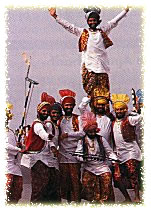
day the people are in a festive mood. Traditional dances are done
in the fairs with youngsters joining the folk groups and having
a gala time dancing with them. Men perform the vigorous Bhangra
dance with energetic steps to the beat of dholak (traditional drum)
while women perform Gidda dance with great fervour and rhythmic
steps. Typical Punjabi food is served everywhere that is relished
by each and everyone.
On a very cheery note the festival
ends with huge family gatherings and picnics. Baisakhi is one of
the biggest festivals of Punjabi and is grandly celebrated in villages.
|