| 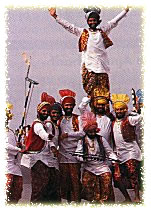 With
the swing of festivals starting from Rakhi, Navratri- the festival
of Goddess Durga also passed with people celebrating it joyfully.
Lots of colours, beautiful ghaghras and cholis, attractive accessories
like bangles, black metal jewellery, traditional tattoos, mojiris
and the list goes on. With
the swing of festivals starting from Rakhi, Navratri- the festival
of Goddess Durga also passed with people celebrating it joyfully.
Lots of colours, beautiful ghaghras and cholis, attractive accessories
like bangles, black metal jewellery, traditional tattoos, mojiris
and the list goes on.
This nine-day festival is extravagantly
celebrated in the pooja of the nine incarnations of Goddess Durga.
Each day is meant for one of her incarnations. All over India this
festival is celebrated splendidly. People belonging to different
caste celebrate this festival in their own unique way.
The North Indians fast for eight days
and perform a big pooja on the eighth and the ninth day. The eighth
day is called ashtami. On this very day, people break their fast
by worshipping Goddess Durga and then feeding eight small girls
and one small boy. An important thing in this fast is that the food
people eat, should not contain onion and garlic. Non-vegetarian
food is also avoided during this fast. Apart from fasting, traditional
dances called garba and dandiya are done during all the nine days.
All the people in the north do these dances enthusiastically. Both
dandiya and garba are special gujarathi dances, which have gained
prominence all over India today.
When talking about garba, this dance
is done by swinging the body front and back and then going round.
It also includes clapping of hands to the beats of the drums. With
the goddess placed in the center of the place people do garba dance
around the idol in the view of appeasing and thanking the goddess
for her blessings. Both men and women perform the dance together
in circles.
Coming to dandiya, this dance is
done with the help of two traditionally decorated sticks. These
sticks are made of wood, measuring 80-85cm in length. They are covered
with colourful cloth and bright colour ribbons around them. Ghoonghurus,
shells and jhumkas are attached at both the ends of the stick. These
sticks are not meant for hitting each other rather hit each other’s
stick to the tune of the music played. This dance is done in couples.
It is also done in groups of even numbers. The steps are usually
hitting alternate sticks of your dancing partner with the rhythm
of the music. This dance also involves sitting and bending of dancers.
A lot of flexibility is needed to perform this dance.
Both the dances are performed bare
footed since it is considered to be worshipping Goddess Durga. People
dance to the tunes of Gujarati and Marwadi bhajans. Also a garba
pot dance is performed with the pot placed on the head. The pot
is beautifully decorated with flowers, betel leaves and coconut
at the top.
Let us now converse on the lovely
and colourful costumes that men and women wear while performing
garba and dandiya. For the girls and the women, ghaghra choli is
the traditional dress that is worn. It is a three-piece dress with
choli on the top, ghaghra as bottom and dupatta tucked in Gujarati
manner. These ghagras and cholis are made of cotton and bandhini
with beads, shells, mirrors, sitars and embroidery work done on
it. For boys and men, kafni pjyamas are worn with kediyu-a short
round kurta above the knees and pagadi on the head. As far as accessories
are concerned, women wear mati, jhumkas, necklaces, bindi, bajubandh,
chudas and kangans, kamarbandh, payal and mojiris. Well for men
the list is not that exhaustive it is just the bandhini dupatta,
kada and mojiris.
Oh my! If discussing about a Gujrati
festival, how can the delicious food be not talked about. The delicacies
of Gujarati food are I think everybody should have a taste of. Special
Navratri food like kachhe kele ki sabzi, kootu rajgiri parathas,
coconut chutney, pumpkin chutney, potato pumpkin pancakes, arbi-yam
oondhiya, navratri raita, navratri salad and batata wada are had
during these nine days.
Slowly, people of other castes have
also started enjoying theses dances. Garba and dandiya today, are
performed in every part of the world. On the other hand, in the
south, people worship each goddess on her special day and on the
ninth day a dance named bathkamma is performed. On the tenth day,
the festival of dasara is celebrated.
With globalization at its peak, fusion
of cultures and customs is booming in all parts of the world. People
now enjoy and celebrate all the festivals everywhere be it Christmas,
Diwali or Id.
So keep dancing to the tunes
of these colourful festivals because it is saro che!
|