Nowadays, there is no shortage for cricketers who show their heroism in matches with upcoming teams and outperform on native pitch. Let’s have a look at the story of this legendary cricketer who stole the moments when he represented team India ante-independence.
Nayudu's mother tongue was Telugu, but he grew up in Nagpur and played almost all his cricket in the central India. He showed tremendous promise as a schoolboy cricketer.
He was a popular cricketer ever since he made his first class debut in 1916. For Hindus against Europeans, he came in to bat at No.9 with his team at 79 for 7. He blocked his first three balls and hit the fourth for six. That established a reputation that lasted till the end of his career.
In 1923, the ruler of Holkar invited him to Indore and made him a captain in his army. Arthur Gilligan led the first MCC tour to India in the 1926-27 season. |
 |
| Full Name: Cottari Kanakaiya Nayudu |
| Born: October 31, 1895, Nagpur, Maharashtra |
| Mother tongue: Telugu |
| Died: November 14, 1967, Indore, Madhya Pradesh |
| Major teams: India, Andhra, Central India, Central Provinces and Berar, Hindus, Holkar, Hyderabad, United Province |
| Batting style: Right-hand bat |
| Achievements:India's first Test captain; first cricketer to be honoured with the Padma Bhushan; Wisden Cricketer of the Year 1933 |
| Relations: Brother - CL Nayudu, Brother - CR Nayudu, Brother - CS Nayudu, Son - CN Nayudu, Son - P Nayudu, Grandson - VK Nayudu |
|
|
In 1926-27 at Bombay Gymkhana, he gained prominence by hitting 153 (including eleven 6's and thirteen 4's) out of 187 in just over a hundred minutes for Hindus against A. E. R. Gilligan's M.C.C. team. One of the sixes, off Bob Wyatt, landed on the roof of the Gymkhana.
Colonel Cottari Kanakaiya Nayudu, fondly known as CK, captained India in their first Test against England in 1932.
CK’s mark in the game of gentlemen and Maharajas:
India made its first Test tour of England in 1932. The Maharaja of Patiala was picked as the captain, Ghanshyamsinhji of Limbdi as vice-captain and the Maharajkumar of Vizianagram took the new post of deputy vice-captain. Two weeks before the trip, Patiala dropped out on reasons of health and the Maharaja of Porbandar took over. Nayudu took part in all twenty six of the first-class matches on the tour, scoring 1,618 runs at an average of 40.45 in the first-class matches and 1,842 overall, and taking 65 wickets. Wisden chose him as a Cricketer of the Year the next year.
 C.K.Nayudu (1895-1967)
Portrait in India Ink by V.N. O'key |
CK hit 32 sixes, which was the most by anyone in the season. Playing at Edgbaston, he hit a ball into the River Rea. The river forms the boundary between Warwickshire and Worcestershire, so CK in effect hit the ball into the next county.
That was at Lord's in 1932 when, despite a painful hand injury received when fielding, Nayudu made top score, 40, in the first innings. With six centuries, the highest of which was 162 from the Warwickshire bowling, he headed the batting averages for all matches with 37.59 and took 79 wickets. He also played in three Tests against England in 1933-34 and three in the tour of 1936, when he again exceeded 1,000 runs and dismissed 51 batsmen in first-class fixtures.
Limbdi was a decent cricketer, but Porbander was not. Just before India's inaugural Test, while making a hundred against Eastern counties, Limbdi suffered a back injury which ruled him out of the Test. Porbander decided that Nayudu should be the captain but not everyone was ready to accept. At 4 am on the morning of the Test, a group of players woke Porabander up to say they would not play unless Nayudu was demoted. Hectic parleys followed between those in England and India, and finally Patiala ordered that Nayudu was the captain and the other players had to play as his squad.
Again at Bombay Gymkhana…
In the 1933-34, Douglas Jardine visited India with a formidable, though not full strength, MCC team. For Punjab Governor's XI, Nayudu scored a hundred against them. CK was retained as the captain of the Test series. The first ever Test in India, held at the Bombay Gymkhana between December 15 and 18, were watched by over a 100,000 spectators. India conceded a lead of over 200 but in the second innings Lala Amarnath scored a brilliant hundred and added 186 for the third wicket with Nayudu.
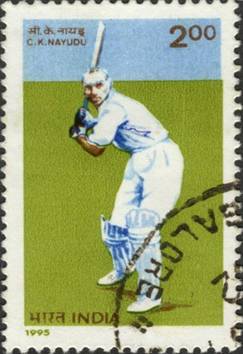
Detail from a stamp released to honor sportsman C.K. Nayudu
Though never on the winning side in a Test match, he helped Vizianagram to inflict by 14 runs the only defeat of the tour upon D. R. Jardine's powerful M.C.C. side in 1933-34, taking four wickets for 21 runs in the second innings.
Despite being up against a full-strength English side, Nayudu marshaled his resources superbly to help India put up a fighting performance.
Over six feet tall and of athletic build, Nayudu was known to plunder opposition attacks with his robust hitting. Tall and well proportioned, Nayudu was specially strong in driving, bowled accurately at slow-medium pace and was a fine fielder. It was a delight to watch C. K. at the wicket. No one else has played at least a first-class match in six decades.
He played first-class cricket regularly till 1958, and returned for one last time in 1963 at the age of 68. He also shone at hockey and association football. In his later years CK, who excelled at several other sports, became a selector and administrator, though even then intrigue and controversy followed him. He maintained his old standards too. In an unofficial Test against the 1950-51 Commonwealth XI, Hazare, cut over the eye by a Ridgway bouncer, retired for repairs. A furious CK, chairman of selectors, stormed into the dressing-room and sent him back to the fray - wound unstitched.
His family strove to emulate him. Besides Test legspinner CS, and another brother, CR, CK's son and grandson were first-class cricketers - and his daughter is a radio commentator.
Despite his very short international career (only seven Tests) he became a sort of a cult figure in Indian cricket and a grateful nation honored him with the Padma Bhushan in 1956, the third highest civilian award presented by Government of India.
In his footwork he had the elegance of an artiste and in his judgment the precision of a scientist. His hurricane hitting across the fence thrilled the spectators and unnerved the opponents. With his death an epoch in Indian cricket came to an end. |

