Untitled Document
Bhogaraju Pattabhi Seetaramayya
|
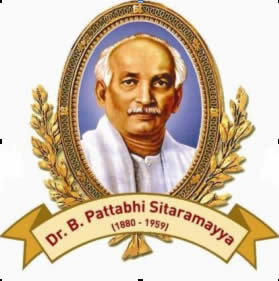 |
Freedom Fighter, Educationalist, Economist, Editor, Doctor and a great visionary of Andhra Pradesh.
Bhogaraju Pattabhi Seetaramayya was born on November 24th, 1880 in Gundugolusu village of Godavari district of Andhra in a poor Brahmin family. His father was Subrahmanyam and mother was Gangamma. He had a difficult and impoverished childhood due to his father�s premature death. However, with determination and hard work, he finished his Intermediate (12th standard) with A grade (first class) and graduated from Madras Christian College and Madras Medical School. He got married when he was in school to Rajeswari, daughter of Venkataratnam Ganjam, a wellknown lawyer.
Pattabhi who had a BA, fulfilled his ambition to become a medical practitioner by securing a M.B.C.M. degree. In 1906, he started his practice as a doctor in the coastal town of Machilipatnam. He established Jatiya kalasala (National College) in Bandaru in collaboration with Hanumantarao Kopalle and Krishna Rao Mutnuri.
Fight for Free-Andhra:
In 1913, first Andhra Mahasabha (Andhra great meeting) was held and a resolution was passed to carve out an Andhra state from the Madras province of British India as part of creation of states on the linguistic nationalities. That year, Dr. Bhogaraju published a book entitled, "For and Against Andhra Province."
|
Writing with a purpose:
He also participated and motivated many to participate in Bordoli satyagraha (civil disobedience) and salt satyagraha movements. In 1929, he became Congress working committee member. He went to jail in 1930 for participating in Salt satyagraha movement. In Jail, he wrote "khaddaru utpatti - daani avakaasalu." He studied the constitutions of twenty countries and wrote "Consttitutions of the World." He wrote "History of Congress" part 1 in 1936 and part 2 in 1947. This book was translated into Telugu by Anjaneyulu Kodali.
He started an English weekly, Janma Bhoomi, in 1919 and it was shut down when he was jailed in 1930.
A new monthly journal, States People, was started under his editorship in 1938. His writings include
jaatiya vidya, gaandhi siddhaantam, saamyavaadam, bhaashaprayukta raashtra vibhajana, khaddaru, hindu samishti kutmbasamskriti, congresuku enduku votucheyaali, feathers and stones, aravai samvatsaraala congresu, and Hindu Home Rediscovered.
As a freedom fighter, MP and Governor:In 1916, he plunged into "home rule" movement by retiring from his lucrative medical practice. In 1917, during the All Indian National Congress meeting, he convinced the Congress party members to establish a special Andhra State Congress Committee, which was formed in 1918. He spoke in support of Mahatma Gandhi's Non-cooperation resolution in Nagpur.
He presided over the 5th meeting of Indian kingdoms and principalities in Karachi in 1936. He also presided over the meeting of Indian kingdoms and principalities again in 1938 in Navpari.
He was recruited to run for the presidency of the Indian National Congress as the candidate closest to Mohandas Gandhi in 1939.
Serving on the Congress Working Committee when Quit India was launched in 1942, Pattabhi was arrested with the entire committee and incarcerated for three years without outside contact in the fort in Ahmednagar, Maharashtra. During this time he maintained a detailed diary of day-to-day life during imprisonment, which was published later as Feathers and Stones.
He was elected as president of the Congress Party in 1948. He ran successfully for Congress presidency in 1948, winning with the support of Jawaharlal Nehru, then Prime Minister of India. He served as a member of the Indian Parliament from 1946 through 1952 and as the Governor of Madhya Pradesh from 1952 through 1957.
As economist:
He founded Krishna Cooperative Central Bank and started a journal "Cooperation" in 1915 and Andhra Bank in 1923 as its director. He also founded Bharat Lakshmi Bank in 1929, and Hindustan Ideal Insurance Company and Andhra Insurance Comapny in 1925.
Dr.Bhogaraju Pattabhi Sitaramayya established Andhra Bank in Machilipatnam on 28 November 1923. Andhra Bank is currently one of the major commercial banks of India which, has 1,179 branches as of September, 2005. Andhra Bank was the pioneer in introducing Credit Cards in India during the early eighties.
In advertisements put out in 2006, the bank claimed to be "No 1 in Asia for return on capital" and having moved "up the world ranking by 277 notches to reach 683rd global ranking".
It sourced some of this information to The Banker of London, a Financial Times of London Group of Business Publications, of July and August 2005.
It has 130,000 shareholders, 13.72 million customers and 13,922 employees "spread across the length and breadth of the country" with an awesome revenue of Rs. 3,133 crore (as of 2005).
He retired to settle in Hyderabad in 1957 from his active social life and died in 1959. He was one of the greatest Indian leaders, who worked hard for the all-round development of Andhra Nation. |
| |
|
|
|
|
|

