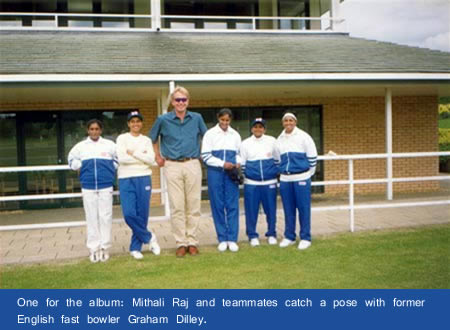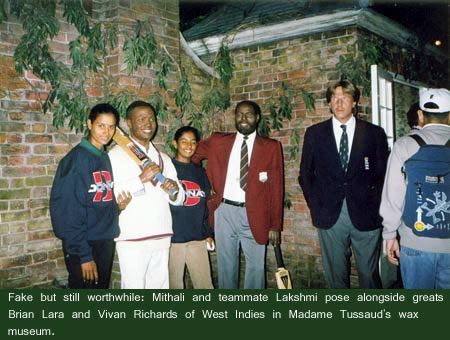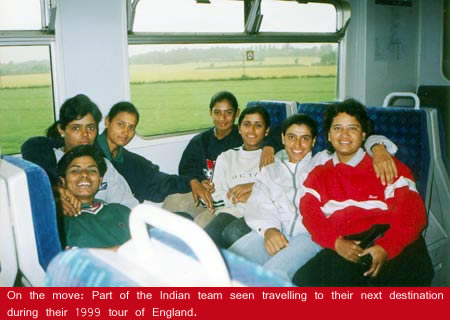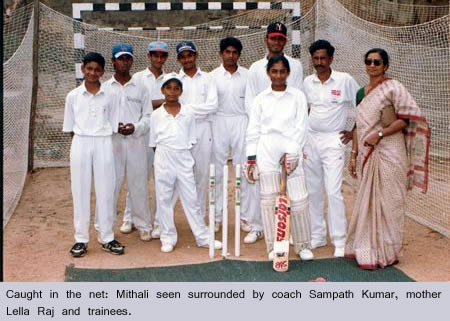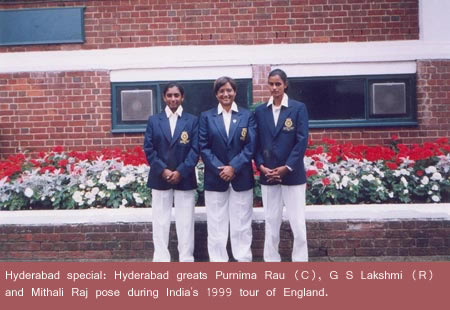
Mithali Raj (December 3, 1982) is the captain of the Indian women's cricket team. She made her one-day international debut in 1999 against Ireland at Milton Keynes and scored 114 runs without getting out in that match. She made her test match debut in the 2001-02 season against England at Lucknow.
She became famous for her score of 214 runs in a test match against England at Taunton, which broke the record for the highest score in women's Test cricket. She led the Indian team to the finals in the Women's World Cup 2005 where the team lost to Australia. She is a part-time bowler as well. She is a recipient of the Arjuna award for the year 2003. As a child, she trained in Bharata Natyam, an Indian classical dance and gave stage performances. She is employed wit h the Indian Railways.
She has been designated as Ambassador for the Girl Child project of Prayas, a city-based NGO involved in the campaign to eliminate violence and discrimination against girl child. As an ambassador, she would try to live up to the expectations.
|
In fact Raj wasn't into sports at all; she was a dancer, having studied classical Indian dance in her native Hyderabad from the age of six. "Dance has always been my first love," she muses, "but I had to quit because I was making rapid strides in cricket." You can say that again.
And indeed such has been the stigma of playing cricket that many Indian families have eschewed letting their girls play. Raj's own mum would still prefer her to be a dancer, although she is supportive of her decision. "She's always given me a choice and encouraged me to the best in whatever I do." Her dad is just delighted; he always wanted her to be a cricketer.
But the consequences of the BCCI, the world's richest cricket board, taking women's cricket under its far-reaching wings don't stop there. "That was a big boost," Raj confirms. "Before it there was no money no match feeds, there was nothing in women's cricket apart from the passion or the satisfaction you get playing." She shrugs. "But now there are job opportunities which might attract families to support their girls." |