Hi
Friends, What are you going to do this Sankranti?
Sankranthi, it is a big event for the people of Andhra
Pradesh. We, Telugus like to call it 'Pedda Panduga'
meaning big festival, especially a real festival for
farmers. In the coastal regions, it is a harvest festival
dedicated to Indra. The whole event lasts for four
days, the first day Bhogi, the second day Sankranti,
the third day Kanuma and the fourth day, Mukkanuma.
Why
Sankranti?
Times have been changed a lot. Many people are taking
up different professions according to their choice
or according to the flow of fast bucks. Heredity in
occupation is not going on, and based on the work
life style has been changed; priorities like food,
attire and usage of languages have been changed.
Festivals celebrated at other places have got equal
importance in India, as the organizations we work
with are deeply rooted in those countries. So we consider
their joyous moods as ours and there is no wrong in
that but how many people are aware of purpose of celebrations
and significance of festivals.
Many Indian Festivals are being considered as holidays
to relax, to watch movies, to try traditional wear,
or to exhibit their status to neighbors and to relations.
Ask someone “why Sankranthi?” the response
would, usually, be in two ways.
“It is shown as a festival in the calendar;
everybody is in a festive mood, so are we”
“The main source of living in India is agriculture
and our families are related in one way or other with
that; wherever we Telugus may live it is customary
to share the pleasure of agriculturists”
Makar
means Capricorn and Sankranti is transition
There is a Sankranti every month when the sun passes
from one sign of the zodiac to the next. There are
twelve signs of the zodiac, and thus there are twelve
sankranti's as well. Each of these Sankranti's has
its own relative importance but two of these are more
important - the Mesh (Aries) Sankranti and the most
important, the Makar (Capricorn) Sankranti. Transition
of the Sun from Sagittarius to Capricorn, during the
winter solstice in the northern hemisphere is known
as Makar Sankranti.
Good
Luck-day to start something great
From this day begins the six-month long Uttara-yana,
considered very auspicious for attaining higher worlds
hereafter. So this day was seen as a sure-shot Good
Luck day to start your journey or endeavors to the higher
realms beyond. From Uttarayana starts the ‘day’
of Devatas, while dakshinayana is said to be the ‘night’
of devatas, so most of the auspicious things are done
during this time. Uttarayana is also called as Devayana,
and the next half is called Pitrayana. While the traditional
Indian Calendar is basically based on lunar positions,
but sankranti is a solar event, so while dates of all
festivals keep changing, the english calendar date of
Makar Sankranti is always same, 14th January.
It’s a sunny festival
“Escalation of mankind should lead the world towards
light, not towards dark”
Makar Sankranti is the day when the glorious Sun-God
of Hindus begins its ascendancy and entry into the Northern
Hemisphere; and thus it signifies an event wherein the
Gods seem to remind their children that 'Tamaso Ma Jyotir
Gamaya'. May you go higher & higher - to more &
more Light and never to darkness. Sun for the Hindus
stands for Pratyaksha-Brahman - the manifest God, who
symbolizes, the one, non-dual, self-effulgent, glorious
divinity blessing one & all tirelessly. Sun not
only represents God but also stands for an embodiment
of knowledge & wisdom.
Let
your father’s head be held high by the life &
deeds of his children
Lord of Makara Rashi is Shani is visited by Sun. Father
(Sun) in fact himself comes to his son’s house,
for a month. This day symbolized the importance of special
relationship of father & son. It is the son who
has the responsibility to carry forward his fathers
dream and the continuity of the family.
Dawn
of Sankranthi day is high time to meditate
Get up early in the morning, before sunrise, have bath
and be ready with water & flowers for the sunrise.
Worship the rising Sun, by offering water, flowers with
both the hands & then pray with folded hands by
chanting the Gayatri Mantra and pray for knowledge,
wisdom and enlightenment to rise in the similar way
to greater & greater heights. Pray for blessings
to live a dynamic, inspired & righteous life.
Do tarpan for your ancestors. Offer water to the ancestors
while praying for their blessings. Resolve to redeem
the pledges & pride of your forefathers. Live life
in such a way that wherever your forefathers may be
their head is held high by the life & deeds of their
children.
Affirm the greatest importance of your spiritual goal
very clearly, and pray to God to bless you with the
capacity to constantly revel in your true self. May
the graph of your rise like the Uttarayana Sun. May
there be greater 'Love & Light' in your life &
the world. Have a special session of Meditation, wherein
you bring about the awareness of the self-effulgent
subjective divinity.
Share
your pleasure with fellow beings
Prepare laddus or other sweets and offer them to your
friends & relatives. See to it that your ‘Well-being
Prayer for all’ gets manifested in action &
deeds. Have the lunch of Chekkara Pongali. This stands
for inculcating simplicity in your life & habits.Give
some Daan on this day to someone who truly deserves.
Visit your son at his place and give presents to the
son and the daughter-in-law. If it is not possible to
visit, then organize to send presents to them to express
your love & affection to them. Work to properly
cultivate the generation, which has to carry forward
all the best you cherish & value.
Those
were the possible things all you can do on Sankranthi.
There are many other things; to welcome Sun, Telugu
women clean their homes and decorate their front yards
with muggulu. Children offer a vibrant salute to lord
of Sun with their kites.
Here
we end..
How busy you may be, take a break and have a glance
at your customs. They will show you the solutions for
many problems you come across in your life. Be proud
to be an heir of one the world’s ancient and rich
cultures.
Guest
speaks
Mr. Laxmi Sekhar Kalepu reveals how Germans incline
towards Indian tradition and he asserts the need to
practice their kind of diligence here in A.P.
Sekhar
teaches German language at Goethe Institut, Hyderabad.
He had been to Germany twice, on a study about the country,
people and culture.
“Germans are just like us. There is a wrong notion
that they are racists; on the contrary, they are open
to all kinds of cultures and people. Though it takes
some time to get acquainted and drive it en route for
a close friend ship, if once a German considers you
as his/her friend you can find the warmth of intimacy
throughout your life.
They are perfectionists. I was astonished when I found
a rich collection of music including our very own beats
of “tappetlu” and lyrics like “yenki
paatalu” with one of my German friends. They always
admire at our rituals like “surya namskarm”
and foods like “puli hora”. They explore
the reason behind every thing whatever they find and
whatever they feel which always keep themselves clear
about their deeds.
Germany is a safe place to live and one has to find
oneself how a common man’s rights are protected
there. Here I should say some thing about the success
saga of a Telugu.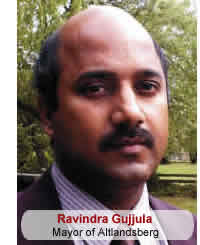
Ravindra
Gujjula comes from A.P., India, studied medicine in
East Germany, started a practice after reunification
and, eleven years ago, first stood for the office of
honorary mayor of Altlandsberg in the state of Brandenburg
- and he is still the mayor today. He rarely gets less
than 80 percent of the vote. His position has brought
him fame and put his small town that lies not far behind
the last high rises of Marzahn on the map. The New York
Times has written about him, the BBC made a film on
his work, Indian radio stations broadcast programmes
about him and he is invited by universities and congresses
all over Germany.
You rarely find Telugu Associations and get-togethers
of Telugu community. Our cottons, Kalamkari designs
and many handicrafts of Kondapalli, Nirmal and Cheryal,
recipes and fine arts like Kuchipudi can always find
a place in the creative and lucid space of their minds.
There is a need to promote our culture first here in
India. South Indian states are recognized by their predominant
attributes, for example when you think of Kerala, nature
cure, resorts and greenery strike first and when you
think of Tamil Nadu architectural splendor of ancient
temples jog on your memory.
There are many striking features which place the A.P.
in the diary of globe trotters. Places like Araku Valley,
Srisailam, Horsley Hills, Amaravati and vivid culture
hailed from Kakateeyas, Rayalu, and Nawabs and many
are there to propagate the glory of Telugus apart from
our sweetest mother tongue. Unfortunately, many tourists
feel bad about some thing here; first is lack of security,
continuously staring at them, charging more bucks for
every service we offer thinking as if every foreigner
is ultra rich, etc.
|